All posts by

The NHS Principles and Rules of Cooperation and Competition

July 25th, 2010

The Principles and Rules of Cooperation and Competition (PRCC), published July 2010, form part of the Operating Framework in establishing the system rules governing cooperation and competition in the commissioning and provision of NHS services in England.  The ten principles include:

“Principle 4: Cooperation and agreements – Commissioners and providers must cooperate to improve services and deliver seamless and sustainable care to patients.”

The guide states “Cooperation is an essential behaviour amongst commissioners and providers of NHS-funded services to share best practice and maintain seamless and sustainable care” with the critical caveat “commissioners and providers should not reach agreements which restrict choice and competition if they operate against patients’ and taxpayers’ interests.”

DH sets out how ‘Responsibility Deal’ will be part of new approach to public health

July 12th, 2010
A series of statements during the first half of July has seen Conservative Department for Health (DH) ministers pick up on their pre-election commitment to Responsibility Deals (voluntary agreements) as a means to tackle public health.  This follows statements from Defra’s Caroline Spellman MP in June launching the prospect of waste Responsibility Deals, and draws on thinking in the 2008 report ‘A light but effective touch’.

On 7 July 2010 in ‘A new approach to public health‘ Andrew Lansley MP, Secretary of State for Health:
“There is no lack of desire for people to be healthy, our job should be to provide the right information, to create the right environment, to incentivise healthy options and build social momentum behind behaviour change in the ways I have already described.

“Nudging individuals in the right direction.  Encouraging positive choices. Not lecturing or nannying. But making people feel empowered.

“Part of this is bringing government and business together to promote innovation in thinking and practice. So we will build on the ideas and expertise from our Public Health Commission, and the Coalition for Better Health, to create a new ‘responsibility deal’, built on social responsibility, not state regulation.

“And this is everyone’s business – there is a distinctive role for all of us to achieve the positive change we need.

“Change4Life is an example of this. I have been impressed how much it has achieved to date – I’ve talked to many of you about my support for it, particularly the way it has brought som many people together – healthcare professionals, teachers, charities, businesses, and the thousands of volunteers who have added their support.

“But, again, we need a new approach. We have to make Change4life less a government campaign, more a social movement. Less paid for by government, more backed by business. Less about costly advertising, more about supporting family and individual responses.

There has been a change of Government and there will now be a change of approach. We will be progressively scaling back the amount of taxpayers’ money spent on Change4Life and asking others, including the charities ,the commercial sector and local authorities, to fill the gap.

“While government pump-primed the brand, we will now withdraw the primer and engage others to share in making Change4Life really work – and we will focus on extending its reach and effectiveness, especially in social media.

“There is no point backing local strategies if the government is prescriptive.  Change4Life can be used by everybody to deliver their public health campaigns.

“To date, industry has made ‘in kind’ contributions. I will now be pressing them to provide actual funding behind the campaign. And they need to do more. If we are to reverse the trends in obesity, the commercial sector needs to change their business practices, including how they promote their brands and product reformulation.

“That is why I see our new approach as a partnership – access to the Change4life brand, alongside the Responsibility Deal; with an expectation of non-regulatory approaches.  We will work with partners in Change4life to give people better information in less prescriptive ways.

“I will also consider extending the Change4Life partnership to the drinks industry, who also have a major further role to play in promoting healthier lifestyles.  Change4life is not just about obesity and physical activity but other ways to be healthy.”

On 8 July 2010 Anne Milton in a speech to the Westminster Health Forum added:
“Legislation has its place and has a role to play in some instances, but we must focus on giving people the means to make the right decisions about their health. On tapping into the power of the group to influence the individual.

“We need to create a large space for health information to help people make good choices.

“Decisions about alcohol consumption must be informed in order to be meaningful. We want to improve alcohol labelling so that people can make decisions about alcohol armed with all the facts, and we are looking closely at the responses to the recent consultation.

“And it’s not to say that we don’t need regulation to ensure that alcohol is traded responsibly.

“The environment in which alcohol is sold and consumed must encourage better decision making, not risk taking.

Reviews on alcohol taxation and pricing will report in the autumn – and I know many of you from industry will be working with us on a Responsibility Deal.

“But it does mean we need to look again at how we can equip people with the right skills to make the right decisions at the right time. So that we can reduce the human cost of alcohol abuse, and the cost to the NHS, too.”

On 12 July 2010, responding to calls by senior doctors to reduce addiction to unhealthy food, a Department of Health spokesperson said:
“‘We need to create a new vision for public health where all of society works together to get healthy and live longer. This includes creating a new ‘responsibility deal’ with business, built on social responsibility, not state regulation.

“Later this year, we will publish a White Paper setting out exactly how we will achieve this.”
Opportunity to improve draft EU Horizontal Agreements Guidelines, says The Cooperatition Incubator

June 25th, 2010

The Cooperatition Incubator has set out five recommendations for improvements to the draft EU Horizontal Agreements Guidelines 2010 in a response to the European Commission consultation.

We welcome the draft EU Horizontal Agreements Guidelines 2010, which is much clearer than the 2001 guidance.  Our response focuses on the “standardisation agreements” guidance (pgs 66-82) and concludes with five recommendations:

1)      The need to include a worked example around a supply chain social voluntary standard, perhaps labour-related, where additional employment costs are passed on to the consumer;

2)      The need to include additional, contrasting, worked environmental examples where increased production costs to deliver qualitative benefits may be passed on to the end consumer;

3)      The need to include best practice guidance and/or examples on what parties to discussions around a potential voluntary agreement should consider “general and aggregated” versus “specific or sensitive” information;

4)      The need to include information on where in EU nations’ competition authorities groups of companies seeking to form voluntary agreements can get advice, such as the unit responsible for ‘Short-form Opinions’ in the UK OFT;

5)      Consideration needs to be given to how the European Commission encourages national competition authorities (and departments for business) to issue guidance that compliments, rather than undermines EU guidance.

The International Chamber of Commerce (ICC) Commission on Competition have raised many similar points to The Cooperatition Incubator in their submission to the EU.

Our submission is also published on the European Commission website.

The Cooperatition Incubator welcomes new OFT Short-form opinions process

June 24th, 2010

The Cooperatition Incubator has today welcomed the UK Office of Fair Trading’s (OFT) announcement that it is establishing a ‘Short-form Opinions’ process.  The first Short-form opinion was issued (27 April 2010) on questions raised by Makro Self-Service Wholesalers Limited and Palmer & Harvey McLane Limited in relation to their proposed joint purchasing co-operation agreement.

In March 2010 Philip Collin, Chairman of the UK Office of Fair Trading announced that the OFT will offer ‘Short-form Opinions’ (SFO). Introducing the new process the OFT acknowledged:

“Concerns have been expressed that uncertainty about how competition law in particular might be applied has led to some forms of potentially beneficial collaborative work between businesses not going ahead. In some cases, it may not be clear how the competition rules may be applied to collaborative conduct, for example with regard to some government-led initiatives.

“As a result, we are proposing to trial a ‘short-form’ opinion procedure. This would allow us, in a limited number of cases, to provide prompt guidance where there is a novel or unresolved issue of wider interest arising in the context of a specific prospective collaborative initiative. We would like to hear from you and your members about issues that you or they think would benefit from clarification through means of such a ‘short-form’ opinion.”

In April 2010 – when they published their first SFO – the UK Office of Fair Trading added:

“Under the Short-form Opinion process the OFT aims to provide guidance, within a prompt timetable, to businesses seeking clarity on how the law applies to prospective collaboration agreements between competitors which raise novel or unresolved competition issues….

“During its analysis, the OFT identified a concern that certain exchanges of information between the firms could potentially lead to a reduction in competition. However following OFT advice, the parties have agreed to ensure the data they supply to each other is general and aggregated, preventing either company from extrapolating specific or sensitive information.

“The new process is being trialled in response to feedback from business that some potentially beneficial collaboration between companies is not proceeding due to concerns about infringing competition law, which carries civil and in some circumstances criminal sanctions.”

Andrew Dakers commented:

“The OFT’s Short-form Opinions process represents a significant step towards addressing the concerns that we have been raising over the past few years that companies are not engaging in collaborative agreements that would deliver public benefit, due to competition law risks.  This new process will help companies mitigate the risks and is a key milestone in our push for a co-regulating, responsible economy.”

“The OFT and Department for Business, Innovation and Skills (BIS) must now set out how the benefits of this change can be independently assessed; how the new process can be communicated across the business community; the extent to which it will enable voluntary horizontal agreements that pass price increases onto the consumer, whilst delivering social/ environmental benefits; and whether there is the necessary capacity in the OFT for resource constraints to not be a barrier to the issuing Short-form opinions.”

Details of the OFT’s new approach can be found here:

DEFRA to develop waste ‘responsibility deals’, says Spellman

June 15th, 2010

Announcing the Coalition Government’s commitment to establishing ‘Responsibility Deals’, Caroline Spelman said in speech at Futuresource, ‘Waste – new thinking for a new economy’ that a Waste Review would look at “new approaches to dealing with commercial waste and promoting ‘responsibility deals’, reducing the amount of waste generated by production and retail.”

Spellman went on to say:

“I want business and manufacturers to redouble their efforts to drive down the waste generated by production and the amount of packaging they use – some of which is, if we’re honest, actually marketing material. Because, as with so much else when it comes to waste, doing the right thing makes sound economic sense.

“Major retailers now report on their environmental performance to consumers and investors alike. Posters on the tube trumpet light-weight beer bottles. Utility companies use energy efficiency to sell their services.

“And, at a time when consumers are tightening their purse strings and investors are erring on the side of caution, what savvy business wouldn’t choose to save money while enhancing their corporate reputation?

“Businesses – inevitably – produce more waste than households.

“For too long, Government attention has been focussed on domestic waste, rather than giving businesses the encouragement they need. Not by tying you up in red tape or by stifling you with regulation. But by supporting you in ways that protects the environment and consumers while encouraging action.

“Using the idea of Responsibility Deals, for example, we will work together with retailers and the business community to continue to drive down food waste and unnecessary packaging.

“You have our support when it comes to both reducing the amount of waste you produce and in ensuring you have the facilities and opportunities to recycle what’s left.

“For decisions to work, they need to be taken as close as possible to the people and businesses involved.

“Some of our waste and resource policies of course, have to be decided at a national, European and even a global level.

“My Ministerial team and I, including the tireless Oliver Henley, who leads for us on waste and has been visiting exhibitors this morning – will be active at every level.”

This message was repeated as the Waste Review was launched on 29 July: “How voluntary ‘Responsibility Deals’ with businesses can play a role in waste reduction and more efficient use of resources”

‘The Cooperatition Incubator’ will be providing feedback to the review from a competition law perspective, and you can send in your own comments.

Corporate Responsibility is the thread that runs through Coalition Agreement – but there’s more work to do…

May 23rd, 2010

The Coalition Agreement: our programme for governmentIn a posting on his personal website Andrew Dakers looks at the Coalition Agreement from a Corporate Responsibility perspective.  Whilst it has much to be commended, he concludes that unfortunately for a Coalition that wants to roll back the state and repeal legislation there is no reference to Responsibility Deals (voluntary agreements) in the Coalition Agreement. He says, “We can only hope the Coalition Agreement commitment to ‘investigate further ways of improving corporate accountability and transparency’ (pg 10) provides the window of opportunity for the Department for Business, Innovation and Skills (BIS) to start thinking more creatively in this area under the leadership of Secretary of State Vince Cable MP.”

He particularly highlights the Conservative-commissioned Public health Responsibility Deal report ‘We’re all in this together’ (2009) that acknowledged business concerns about competition law constraints: “One of the problems of encouraging co-operation among businesses to achieve social goals is the approach taken by the competition authorities to any evidence or suggestion of cartels or collusion. What business requires is a clear steer from Government that co-operation to address health issues can take place in a carefully regulated forum. Recommendation 6.4: Government attention must be given to competition issues that arise from actual and potential industry voluntary agreements. Where businesses can work together to deliver health improvements, Government should find a way of providing a safe haven for companies to discuss solutions that would otherwise risk contravening competition law.” (pg 19)  This approach already exists and operates successfully in the Australian competition law framework.

Andrew said at the Liberal Democrats conference in Autumn 2009: “Sure sometimes there is going to be collusive behaviour that drives excessive profiteering and is against the interests of the consumer. This abuse of market power must be cracked down on hard. However there are also great business leaders and companies – even in the finance sector – who would encourage their peers to take more voluntary action on environmental, social and corporate governance issues if they had the tools in competition law. This is particularly necessary when government is one step behind public opinion and scientific evidence – or when government would be over-reaching itself by producing yet more legislation and enforcement bureaucracy. Or when achieving the vast changes in business practices required needs sector ownership of the problem…. Taking this balanced view, that doesn’t tarnish all business with the same brush, is so necessary if we are to shape a new era in capitalism.”

He concludes that reform of competition law that considers its interaction with voluntary agreements as a means of advancing responsible business practice is the gaping hole in the Coalition Agreement corporate responsibility measures – particularly when sometimes more responsible practices demand an increase in the cost of goods or services to the consumer.

Does fashion sector offer opportunity to test ‘Responsibility Deal’ concept?

January 31st, 2010
As an article in today’s Times newspaper once again raises questions regarding low wages in the fashion supply chain, The Cooperatition Incubator asks whether this could be an area for major fashion retailers to establish a ‘Responsibility Deal’.

Key perspectives expressed in the article were:
  • Tony Nadaraja, chief executive of the Hirdaramani Group, a company that supplies Marks & Spencer, Tesco and Asda, said that the basic 8,000-8,500 rupees (£43-£46) of his machine operators was not a “living wage”.  Even with allowances and bonuses, average pay was £67-£70, he added: “We need to find ways of paying them about 15,000 rupees, at least, to allow them to live.”
  • Ashroff Omar, chief executive of Brandix, said the average monthly overtime worked in 2009 was 38 hours.  M&S and Brandix emphasised other benefits for workers including bonuses, a subsidised lunch and medical facilities. The factory has won international awards for environmental standards.  Both companies said workers would be given a pay rise of £2.70-£3.34 a month this year.
  • Workers at the Brandix Seeduwa plant, which produces M&S trousers, said that basic monthly salary of £45 to £50 barely covered rent, food and clothes.  Meeting other costs was difficult, they said, even though the factory provided for some of their needs — offering, for instance, subsidised food and free medical care.  Wage slips indicated that they regularly worked 35-50 hours overtime each month for a premium rate of 34p an hour.
  • Marks & Spencer said: “It is our view that M&S is one of the UK’s leading retailers for ethical performance out of the ETI membership. Unlike many other retailers, we have a permanent ethical compliance team on the ground in Sri Lanka … to ensure that suppliers meet our high standards.  There is no one definition of a living wage. We strongly believe that Brandix Seeduwa factory wages are very fair relative to the cost of living in Sri Lanka.”  The company said that machine workers at the Brandix Seeduwa factory, whose basic monthly wage ranged between £45 and £54 in 2009, plus attendance allowances and other benefits, earned over 25% more than the minimum wage in Sri Lanka. M&S said that it would strive to meet the ETI recommendations: “But there will always be some instances of not being able to meet this aspirational code because of the nature of the industry (global and labour intensive). It is the responsibility of the management of the supplier to ensure that this is not a regular occurrence.”
  • Next estimated a living wage at £86.50, even though many workers making its clothes earn less. Next acknowledged that similar 2009 basic wages of £50-£56 for workers making its own T-shirts, jerseys and children’s wear did not amount to a living wage, although bonuses and allowances took the lower figure up to £70.40. It said subsidised lunches were worth an additional £14.  Pam Batty, global code of practice manager, said: “As a basic wage this is less than what we think the living wage in Sri Lanka is, which is £86.50.  Our aim is that workers are able to make a living wage within normal working hours. That’s what we’re committed to in our code but we are not there yet in all cases.”  Next’s view that many garment workers were not earning a living wage was backed by local economists and union officials, who said basic salaries were inadequate.
  • Tesco and Asda said they were trying to drive “sustainable” improvements in the welfare of workers.
  • The Ethical Trading Initiative (ETI), which promotes a code of conduct on workers’ rights, says that a “living wage” ought to be paid — “enough to meet basic needs and to provide some discretionary income”. Employees should not have to work more than 48 hours a week on a regular basis.  The ETI admits there is a gulf between the code and actual pay. “The deplorable reality is that low wages remain a fact of life for many garment workers,” said Stephen Rylance, its spokesman.  In a statement the ETI said that its members, including M&S, Next, Tesco and Asda, were “at the forefront of good practice”. But “in this case the poorest-paid workers are saying they are struggling to meet basic needs. For those, even the efforts of the most responsible retailers are not yet good enough.”
  • Simon McRae, of War on Want, the anti-poverty charity, said: “The grim reality is that none of Britain’s high street retailers are doing the right thing by the people who produce their clothes.”
  • Factory owners were worried that if production costs increased then Sri Lanka could lose out to cheaper countries such as Bangladesh.

Dakers speaks out on Competition Law reform at Liberal Democrat conference

September 23rd, 2009

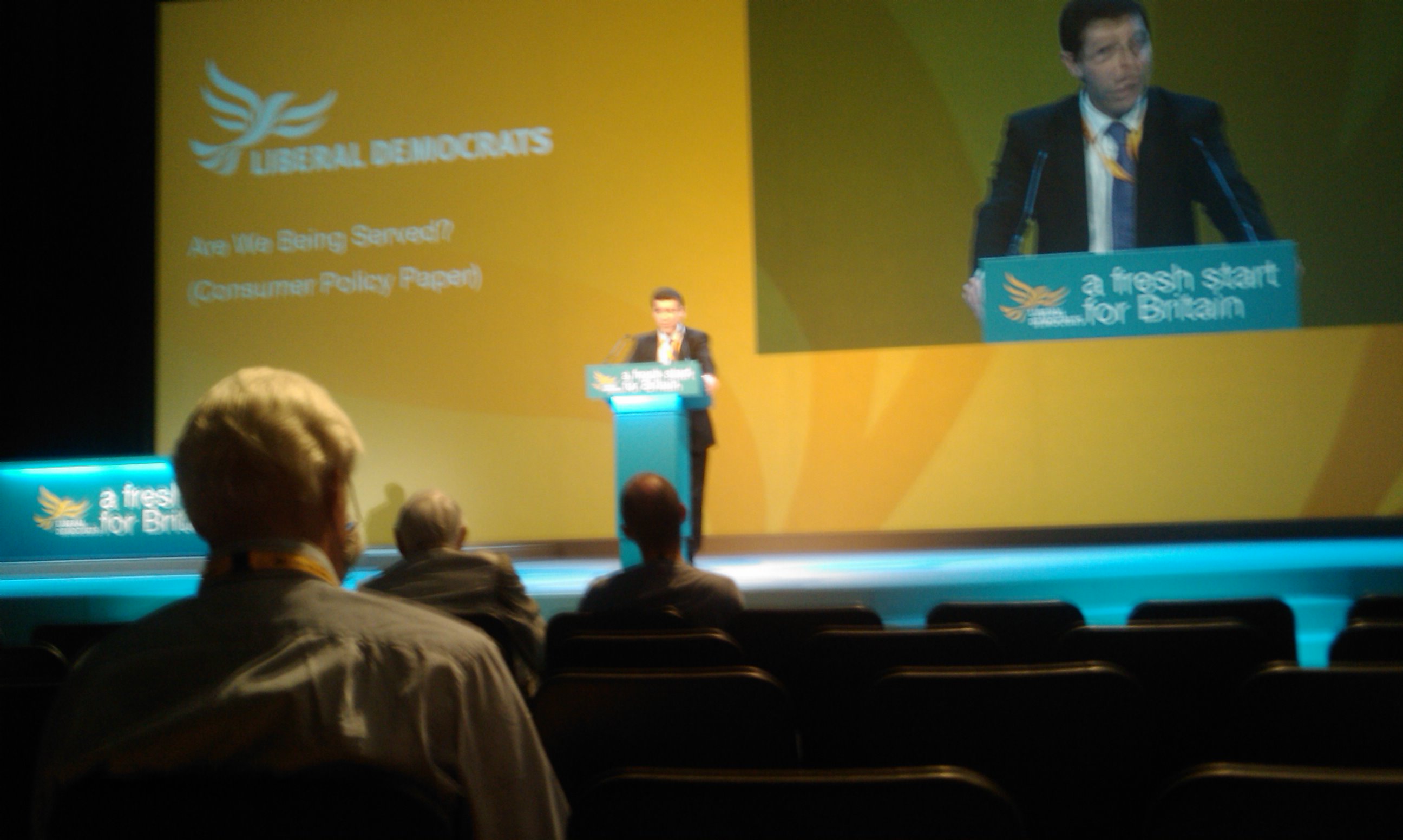
In a speech to Liberal Democrat conference today, Andrew Dakers has urged the party to think afresh on competition law and the role it has to play in corporate responsibility.

He said:

“The paper [Are we being served?] forgets that in reality markets are not just about competition, but also cooperation between businesses. The negative social and environmental externalities that doing business can create will not be resolved by competition alone.

“For the past decade companies that take their responsibilities seriously have run scared of our current competition law framework. In the late 90s this lost both a mechanism for companies that wanted to collaborate on social & environmental issues through voluntary agreements to get these authorised by the OFT, as well as a public interest test. These mechanisms were vital when voluntary agreements involved internalising the external costs of a product and would potentially increase the price to the end consumer.

“The mess of current legislation is well illustrated by the ongoing OFT case regarding supermarkets. Blamed by the public for their low payments to dairy farmers, some supermarkets increased both their payments to farmers and the price to the end consumer. For this the OFT has fined them tens of millions.

“Sure sometimes there is going to be collusive behaviour that drives excessive profiteering and is against the interests of the consumer. This abuse of market power must be cracked down on hard. However there are also great business leaders and companies – even in the finance sector – who would encourage their peers to take more voluntary action on environmental, social and corporate governance issues if they had the tools in competition law. This is particularly necessary when government is one step behind public opinion and scientific evidence – or when government would be over-reaching itself by producing yet more legislation and enforcement bureaucracy. Or when achieving the vast changes in business practices required needs sector ownership of the problem…

“Taking this balanced view, that doesn’t tarnish all business with the same brush, is so necessary if we are to shape a new era in capitalism.

“All of these issues could and should be addressed by this working group. As a party we must produce policy that recognises we’re all in it together: employer, owner, employee and consumer.”

Cement sector cooperation managing competition law constraints

September 11th, 2009

An interview on FT.com (11 Sept 09) with Bruno Lafont, Chief Executive of Lafarge, the French building materials group, highlights what is being achieved by cooperation within the cement production sector.

Asked about the Copenhagen Summit he said: “It is very important that the world together understands what the challenges are. And we should aim to eliminate the risks created by climate change, which are very serious for our children and for the children of our children. There is a need for strong cooperation but [also] an agreement on the goal and how to share the pain, because there will be a cost.”

“Business first should understand the goal and take its share of the goal. For example, the cement business, which has a strong ecological footprint, has taken some actions. We have created cement sustainable initiatives where 30 cement groups are working together at fixing goals, committing to actions, CO2 reductions, improvements in their governance and on their ecological footprint. So that means the sector has started to regulate itself.”

For more information on the Cement Sustainability Initiative visit http://www.wbcsdcement.org/

Significantly the initiative has carefully managed competition law issues:
“Request GNR system data… The PMC will review all requests to determine, first, if the data is available, and second, if responses to the query would fall within the limits of confidentiality and anti-trust constraints adopted for this system.”
Source: http://www.wbcsdcement.org/index.php?option=com_content&task=view&id=66&Itemid=133

“Data Confidentiality …PricewaterhouseCoopers also provides a guarantee of non-disclosure of confidential information and compliance with competition law.”
Source: http://www.wbcsdcement.org/index.php?option=com_content&task=view&id=65&Itemid=132

New Delhi conference to explore non-efficiency factors in competition law

August 25th, 2009

New_DelhiCompetition law is now in place in around 108 countries  including emerging economies like China, Thailand, Korea, Malaysia, Singapore and Vietnam where stringent competitive regulation is considered to be a constructive step to the development of market economy.

The forthcoming International Conference on Competition Law (6-7 November 2009, New Delhi) organised by the World Council on Corporate Governance in association with India’s International Academy of Law aims to examine the status of competition law in various jurisdictions with particular reference to India and the emerging economies where it is being increasingly viewed as an instrument for inclusive growth.

India has been selected as the venue of the conference as it has got a new competition law – Competition Act 2002 as amended in 2007. It has also established the Competition Commission of India with effect from October 2003 and has commenced enforcement of the law with effect from 20 May 2009.  As a consequence, Indian companies are keen to understand the role of the competition lawand its impact on their day-to-day operations.

The conference aims to share information and practice on competition law in various jurisdictions and provide a learning experience for the Indian and foreign companies, law firms, regulatory and judicial authorities and other stakeholders. It also aims to provide a blueprint on how competition law and policy can be evolved to become a powerful tool for fair and competitive markets that, in turn, promote inclusive growth.  

Justice P N Bhagwati, Chairman, International Academy of Law, commented:

“One of the primary aims of competition is to diffuse socioeconomic power of the incumbents and broaden the economic and social base by encouraging participation of new entrants and thus, fostering innovation and growth.

“It improves consumer welfare by stirring up inter-firm rivalry that compels each firm to excel to satisfy the customer by offering better deals and newer products with superior quality at lower prices.”

Andrew Dakers, Founder, The Cooperatition Incubator, added:

“We are really excited that the organisers have decided to include discussion on the social objectives of competition law and non-efficiency objectives in competition law on the agenda.  This makes the New Delhi conference an important milestone in the discussion of competition law and its relationship with responsible practices in individual businesses, across sectors and supply chains.”

Full programme: http://www.wcfcg.net/ICCL_NewDelhi.pdf
Speaker submission guidelines: http://www.wcfcg.net/Papersubmissionguidelines.pdf